INTP Personality Type: Strengths, Careers & Behavior
The INTP personality type combines introversion, intuition, thinking, and perceiving, making it one of the 16 unique MBTI types. INTPs are naturally curious and independent thinkers who enjoy exploring ideas, solving problems, and figuring out how things work. At the same time, they can sometimes struggle with overthinking, procrastination, or expressing their emotions.
Understanding INTP Personality can help you navigate work, friendships, and relationships more smoothly. In this article, we’ll explore their strengths, weaknesses, behaviors, cognitive patterns, and ideal careers, giving you practical insights to understand INTPs better and make the most of their unique talents.
What Is an INTP Personality Type?
INTP is defined as one of the 16 personality types in the Myers-Briggs Type Indicator (MBTI). INTP stands for Introverted, Intuitive, Thinking, and Perceiving. People with this type are usually quiet, thoughtful, and analytical. They enjoy exploring ideas, solving complex problems, and understanding how things work.
INTPs are independent thinkers who often approach situations with logic and creativity. These are known for their love of learning and curiosity. They make decisions based on reason rather than emotions and enjoy analyzing theories and concepts. In work and personal life, they value freedom, independence, and space to think.
INTP Personality Subtypes
The INTP personality type, often called the logician, has two main subtypes that show differences in confidence, self-perception, and approach to life. These subtypes help explain how INTPs react to challenges and handle their thoughts and emotions.
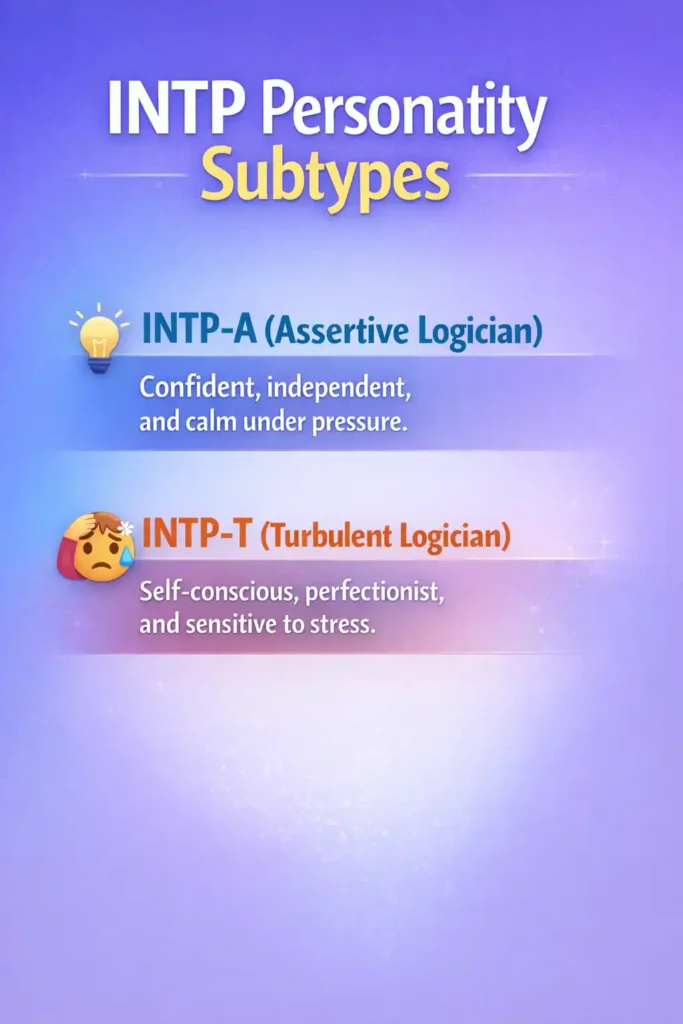
INTP-A (Assertive Logician)
This subtype is more self-assured and comfortable in their own skin. They tend to handle stress better, trust their decisions, and feel more satisfied with their life and circumstances. Assertive INTPs often approach problems calmly and are less likely to doubt themselves.
INTP-T (Turbulent Logician)
Turbulent INTPs are more self-critical and sensitive to challenges. They may struggle with confidence and feel uncertain about their choices, which can make them more cautious or anxious. However, this self-reflection often pushes them to improve and grow, giving them a unique drive to succeed.
How Rare Is the INTP Personality Type?
The INTP personality type is considered one of the rarer MBTI types. Studies show that INTPs make up roughly 3–5% of the population, which means you don’t meet them as often as some other personality types. Their combination of deep thinking, independence, and curiosity sets them apart in social and professional settings.
INTPs are more commonly found among men than women, but both genders share the same core traits: analytical thinking, love for ideas, and a preference for exploring possibilities over following routines.
Key Characteristics of INTPs
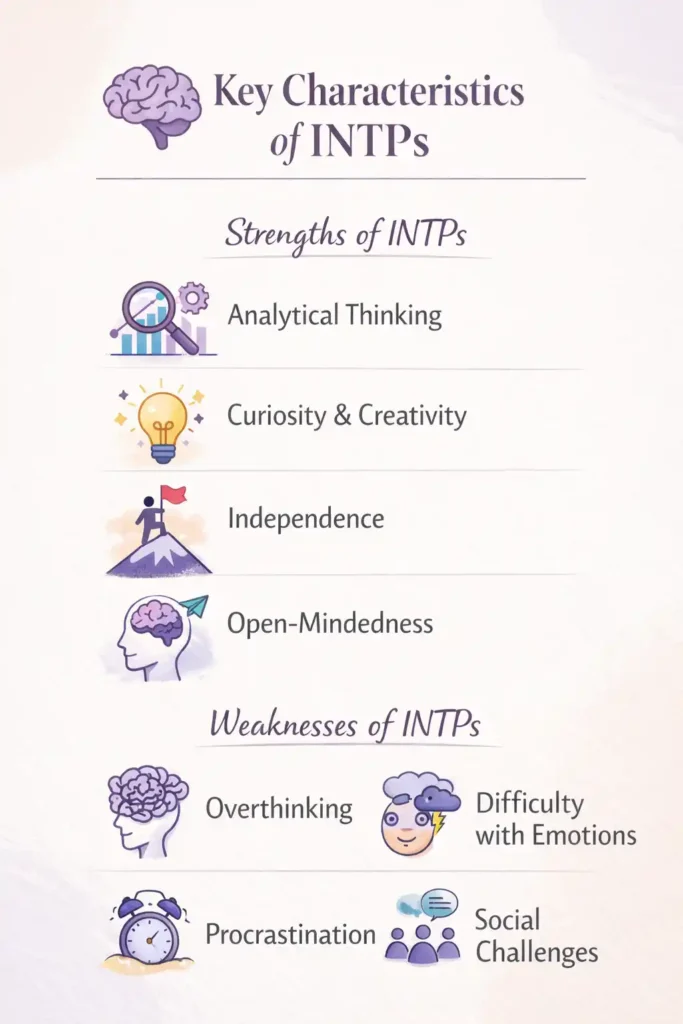
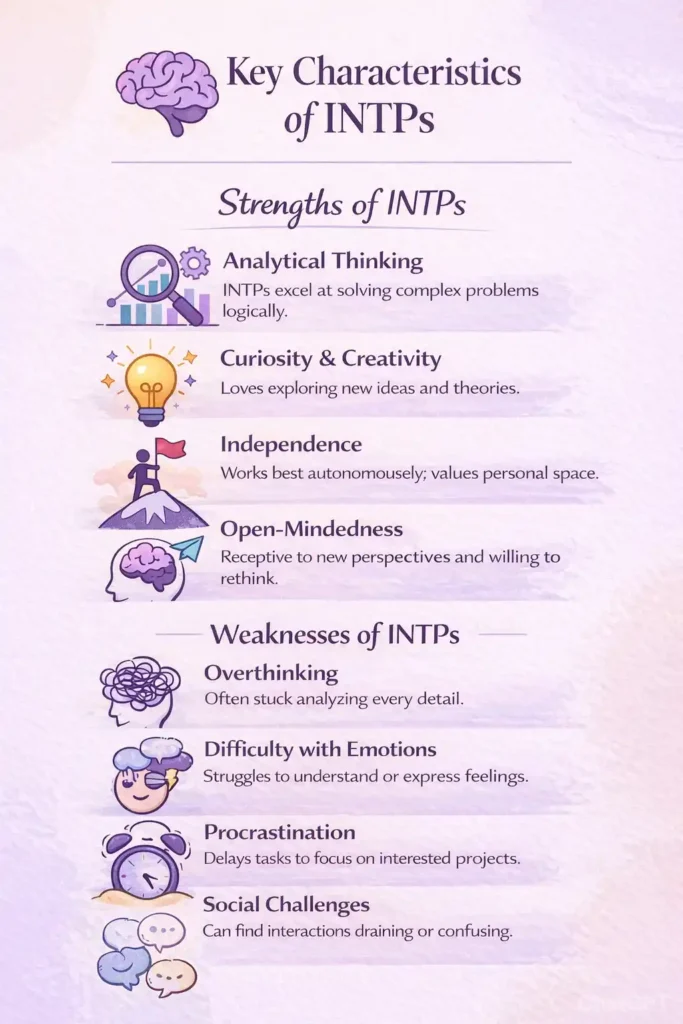
INTPs are known for their curious and analytical minds. They enjoy exploring ideas, solving problems, and understanding how things work. Independent and thoughtful, they prefer thinking deeply over following routines. INTPs often value knowledge, logic, and creativity more than social approval, which can make them seem reserved or introspective.
Strengths of INTPs
- Analytical thinking: INTPs can break down complex problems and find logical solutions.
- Curiosity and creativity: They love exploring new ideas and thinking outside the box.
- Independence: They work well on their own and enjoy self-directed projects.
- Open-mindedness: INTPs are willing to consider different perspectives and possibilities.
Weaknesses of INTPs
- Overthinking: They can get stuck analyzing without taking action.
- Difficulty with emotions: INTPs may struggle to express feelings or understand others’ emotions.
- Procrastination: They sometimes delay tasks if they seem boring or unchallenging.
- Social challenges: INTPs may find small talk or crowded social situations draining.
Common Behaviors and Habits
INTPs often spend time alone reflecting or researching. They enjoy solving puzzles, reading, or exploring abstract ideas. In daily life, they may avoid strict schedules, preferring flexibility and spontaneity. They can also be highly adaptable, changing their approach when they discover a better way to solve a problem.
INTP Cognitive Functions
INTPs use a unique combination of cognitive functions that shape how they think, make decisions, and interact with the world. These functions explain why INTPs are logical, curious, and innovative, yet sometimes detached or reserved. Understanding these functions gives insight into their strengths, challenges, and behavior patterns.
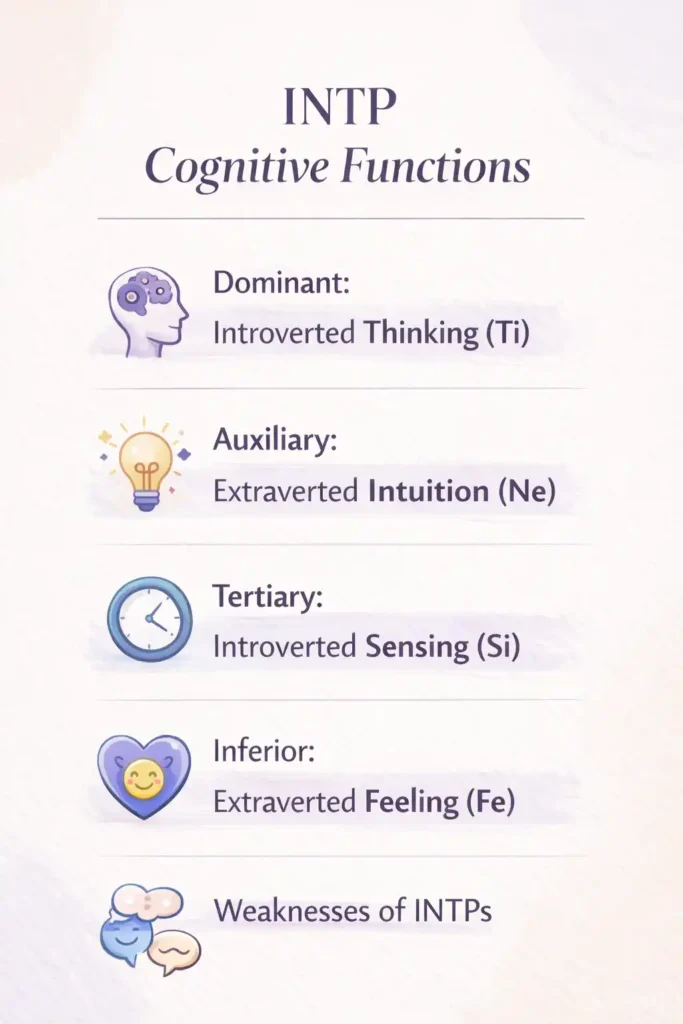
Dominant: Introverted Thinking (Ti)
Introverted Thinking is the core of an INTP’s mind. It drives them to analyze, organize, and understand complex ideas. INTPs use Ti to break problems into logical pieces, find patterns, and create internal frameworks for understanding the world. This function makes them precise thinkers who value accuracy and clarity over emotion.
Auxiliary: Extraverted Intuition (Ne)
Extraverted Intuition helps INTPs see possibilities and connections beyond the obvious. It allows them to explore new ideas, imagine alternatives, and think creatively. Ne works with Ti by providing a wide range of concepts that Ti can analyze, which is why INTPs are often innovative and visionary.
Tertiary: Introverted Sensing (Si)
Introverted Sensing helps INTPs recall past experiences and details, grounding their abstract ideas in reality. While not as strong as Ti or Ne, Si allows them to compare new information with what they’ve learned before, helping refine their understanding and avoid repeating mistakes.
Inferior: Extraverted Feeling (Fe)
Extraverted Feeling is the weakest function for INTPs, which can make emotional expression and social harmony challenging. They may struggle to read others’ feelings or respond in socially expected ways. Developing Fe helps INTPs connect with people, show empathy, and balance their logical thinking with understanding emotions.
INTP Relationship Compatibility
INTPs are often seen as thoughtful, independent, and insightful. Their analytical minds and curiosity make them stand out, but their quiet nature can sometimes make them seem distant or reserved. How people perceive them can vary depending on the setting and relationship.
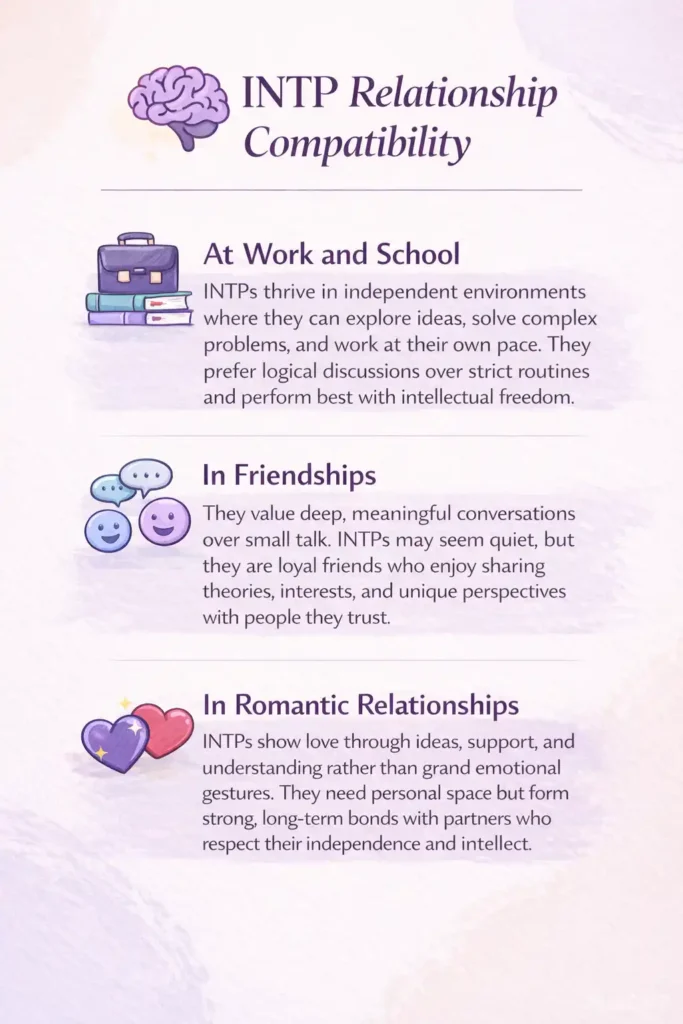
At Work and School
In professional or academic settings, INTPs are problem-solvers and idea generators. They approach tasks logically, enjoy tackling complex challenges, and often come up with creative solutions. Others may admire their intelligence and originality, though INTPs may sometimes appear detached or uninterested in routine tasks or office politics.
In Friendships
As friends, INTPs are loyal, honest, and curious. They enjoy deep conversations and exploring interesting topics. They may not be the most outgoing or social, but friends appreciate their thoughtfulness and willingness to listen. INTPs prefer a small circle of close friends over large social groups.
In Romantic Relationships
In romantic relationships, INTPs are caring, independent, and thoughtful partners. They value intellectual connection and open communication. While they may struggle with expressing emotions openly, they show love through actions, problem-solving, and support. Patience and understanding from their partner help bring out their warmer, more affectionate side.
Career Paths for INTPs
INTPs thrive in careers that allow independent thinking, creativity, and problem-solving. They enjoy exploring ideas, analyzing systems, and working on projects that challenge their intellect. The right career lets them focus on innovation rather than strict routines or micromanagement.
Popular INTP Careers
- Scientist
- Software Developer
- Engineer
- Writer
- Researcher
- Philosopher
- Mathematician
- Inventor
- Analyst
- Professor
Ideal Work Environments
INTPs do best in flexible, low-pressure workplaces where they can work independently. They enjoy environments that provide intellectual freedom, minimal micromanagement, and opportunities to explore ideas. Quiet spaces, project-based work, and creative problem-solving settings allow them to thrive.
Famous INTPs Personalities and Inspirational Quotes
INTPs have made a lasting impact in many fields due to their curiosity, creativity, and logical thinking. These individuals showcase how an INTP’s love for ideas and problem-solving can lead to groundbreaking discoveries and innovations. Some well-known INTP personalities are:
- Albert Einstein
- Kristen Stewart
- Elon Musk
- Tina Fey
- Jesse Eisenberg
- René Descartes
- Charles Darwin
- Marie Curie
- Socrates
- Abraham Lincoln
Some inspirational quotes from INTPs reflect their way of thinking:
- Albert Einstein: “Imagination is more important than knowledge.”
- Isaac Newton: “If I have seen further, it is by standing on the shoulders of giants.”
- Marie Curie: “Nothing in life is to be feared, it is only to be understood.”
How to Interact With INTPs
INTPs value honesty, logic, and intellectual connection. Interacting with them successfully means respecting their need for space, appreciating their ideas, and approaching them with patience. Understanding their unique way of thinking can make relationships personal or professional much smoother.
Dos and Don’ts
Dos:
- Give them space to think and reflect.
- Engage in meaningful, thought-provoking conversations.
- Be honest and direct in your communication.
- Appreciate their creativity and unique perspective.
Don’ts:
- Pressure them into emotional expressions they’re not ready for.
- Micromanage or control their work or decisions.
- Dismiss their ideas as impractical without discussion.
- Expect constant social interaction, they value alone time.
Understanding Their Thought Process
INTPs process the world through logic and possibilities. They analyze information carefully, looking for patterns and connections. Decisions are often made after deep reflection rather than emotion. Understanding this helps you appreciate why they may seem quiet, detached, or slow to act; they are simply weighing ideas and exploring every angle.
Conclusion
INTP personality type shows a balance of deep thinking, creativity, and independence. INTPs bring strong ideas, logical problem-solving, and fresh perspectives, even though they may struggle with emotions, routines, or overthinking at times.
When their strengths are understood and their challenges are respected, INTPs can thrive in careers, relationships, and personal growth. Recognizing how they think and interact helps create better communication, stronger connections, and more meaningful collaboration in everyday life.